“Putting in some work – that’s a couple of hours in a real-life store with a well-lit fitting room and ideally a friend – will ensure the best purchase,” says Fullerton. “Department stores with dedicated denim shops are the best place to start. Whatever your budget, jeans should be an investment so shop with longevity, rather than trends, in mind.”
Fullerton cautions that extremes – skinny and super-wide or ultra-high and low-rises – are more prone to cycling in and out of fashion. “Better to choose a less severe silhouette that will outlast any fad, like a straight leg or modestly wide jean with a mid-to-high rise which will be classic for years ahead,” she advises. “Mid-blue is always the best option for washes.”
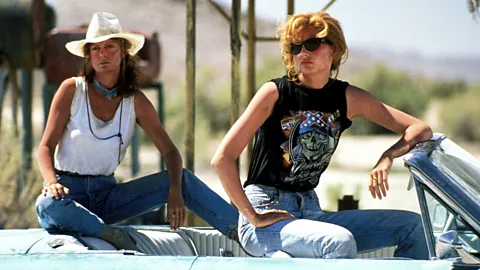
No jean has stood the test of time quite like the Levi’s 501. Patented in 1873 by Levi Strauss and Jacob David in the US, it was originally created as durable, hard-wearing 100% cotton overalls for miners and farmers. But in the early 1950s, blue jeans came to signify youth rebellion, after both Marlon Brando and James Dean wore Levi’s 501s in The Wild One and Rebel Without a Cause. And who can forget Susan Sarandon and Geena Davis denim-clad in high-waisted jeans for Thelma & Louise in 1991.
 Getty Images
“When Japanese selvedge denim replaced the ultra-baggy, hip-hop fits of the mid-to-late-90s, and then Levi’s launched its Red collection of twisted, ergonomic jeans, the denim landscape changed forever,” says denim designer, lecturer and historian Mohsin Sajid. “From then, denim became more elevated, appearing on catwalks and in designer brands’ collections. I was working at Pringle at the time and they asked me to design a selvedge jean.”
The perfect pair of jeans
Today, jeans are firmly part of the fashion mainstream; it’s difficult to find a clothing brand that doesn’t sell them within their collections. And most jeans now contain some synthetic stretch within the cotton mix – normally elastane, which is derived from fossil fuels and sags over time, making them less durable.
As a result, some of the shine has come off the iconic trouser and its Hollywood heyday. The UN estimates that a single pair of jeans requires 1kg of cotton, which in turn, needs about 7,500–10,000 litres of water to grow – the equivalent of 10 years’ worth of drinking water for one person. As an industry, fashion produces 20% of all waste water, and the denim chemical dyeing process can be harmful to both workers and the environment.
 Getty Images
“There’s a reason Levi’s 501 has transcended time; they’re made from 100% cotton, with natural stretch,” explains Professor Dilys Williams, Director of the Centre for Sustainable Fashion at London College of Fashion, UAL. “But we’ve become less used to wearing clothes without synthetic stretch because it’s sold as more comfortable. So, it’s partly about training ourselves – do we need that synthetic stretch? Or could we wear a jean in, and wait for it to shape to our bodies?”
A keen cyclist, Williams tends to get holes in her jeans. Rather than buy a new pair, she proudly patches up existing jeans to reflect her fashion identity and lifestyle. “Each pair tells a story about what has happened whilst they have been worn, the colour fades according to wear, creating a unique patina,” Williams tells the BBC. “This wonderful element has, however, been sabotaged – so many jeans are pre-aged, usually using harmful chemical processes, administered by hand, in countries without strong health and safety checks. The life of the jean is sped up, its production is fast and its identity for the customer lost.”
Try to hold out on washing your jeans for the first few months and don’t wash them too regularly – that way, you’ll develop your own wear pattern – Mohsin Sajid
Choosing raw denim is another way to minimise the environmental impact of jeans. Also known as dry denim, it hasn’t gone through pre-washing or shrinking processes in production, unlike most jeans today. The result is a dark and stiff jean that can naturally fade and soften over time.
“It can be hard to make the switch to such a dark option, but after a few months you’ll never look back,” says Sajid. “Imperfections like slight slubs from the spinning and weaving process make it bespoke and could develop into a great fading jean. Try to hold out on washing your jeans for the first few months and don’t wash them too regularly – if you don’t need to. That way, you’ll develop your own wear pattern.”
Sajid adds that a great pair of long-lasting jeans is a mixture of quality denim – ideally 100% regenerative cotton – using bio-based indigo (no petroleum-based dyes) in a medium 12-13oz (about 354g) weight. For added comfort and stretch, look for brands that use hemp or soft fibres like Tencel Lyocell and Tencel Modal.